
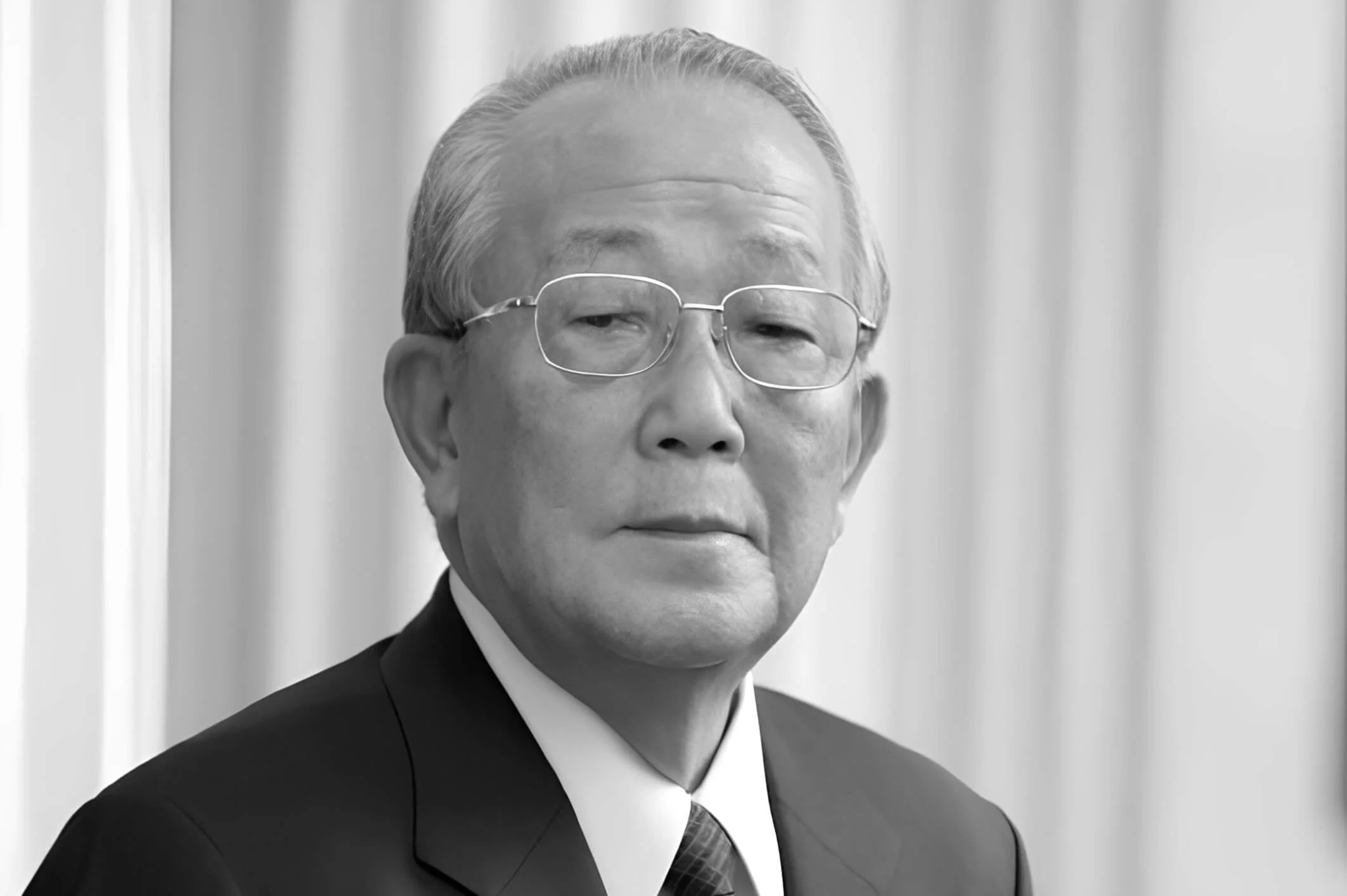
Kazuo Inamori (1932–2022), former Chairman of Japan Airlines, and founder of Kyocera and KDDI
The stakes were national. JAL operated Japan's flagship international routes, employed over 47,000 people, and had already been bailed out by the government three times in the preceding decade. A failed restructuring would have been a national embarrassment. The Japanese government asked a 77-year-old retired industrialist, with no experience in airlines, to take the helm: Kazuo Inamori.
Inamori had built two Fortune Global 500 companies from nothing: Kyocera Corporation, a global leader in advanced ceramics, and KDDI, Japan's second-largest telecommunications carrier. Interestingly, he was also an ordained Zen Buddhist priest.
Within less than three years, JAL became the most profitable airline in the world, posting a record operating profit of ¥188.4B ($2.35B), and relisted on the Tokyo Stock Exchange in the second-largest IPO globally that year, just after Facebook, for $8.5B. The speed and scale of the turnaround remain virtually without precedent.
How did Inamori's intervention succeed where conventional restructuring had repeatedly failed?
A business leadership story about the power of placing meaning at the center of how a business is run.
The Business Leader
Kazuo Inamori was born in the 1930s in Japan and studied applied chemistry before taking a research position at Shofu Industries, a ceramics manufacturer in Kyoto. Frustrated with the company's rigid hierarchy and indifference to his research's commercial potential, he and seven colleagues left to start their own company.
In 1959, Inamori founded Kyoto Ceramic Co, later renamed Kyocera Corporation, with ¥3M (roughly $8,000 at the prevailing exchange rate) in capital from acquaintances. The company manufactured precision ceramic components used inside television picture tubes, and as color television proliferated across Japan in the 1960s, demand surged. Kyocera expanded into semiconductors, solar cells, and electronics, growing into a multinational with over 77,000 employees and annual revenues exceeding $13B. It has never recorded an annual loss.
In 1984, when Japan deregulated its telecommunications industry, Inamori founded DDI Corporation to challenge NTT, the state telecoms monopoly. DDI merged with KDD (Kokusai Denshin Denwa, Japan's international telecom carrier) and IDO (Nippon Idou Tsushin, a mobile operator) in 2000 to form KDDI, which became Japan's second-largest telecom operator.
Early on, way before success, Inamori developed a distinctive management philosophy. When Kyocera had fewer than 100 employees, he wrote the company's Management Rationale, the foundational document governing the company's operations. It stated its purpose as follows: "To provide opportunities for the material and intellectual growth of all our employees, and through our joint efforts, contribute to the advancement of society and humankind."
From this philosophy emerged the Amoeba Management System, which Inamori began developing in the mid-1960s as Kyocera outgrew his ability to oversee every operation personally. The system divides an entire organization into the smallest possible autonomous units, an "amoeba." Each functions as an independent profit-and-loss center, setting monthly revenue and cost targets, tracking performance daily using a metric called "Hourly Efficiency" (added value divided by total labor hours), and transacting with other amoebas at internally negotiated prices pegged to external market rates. Every unit understands its own economics and has the autonomy to act. The core principle was that every individual must think and act as if they were the owner of their own small business: every employee is a manager, every department is a business, every decision has a visible financial consequence. The whole organization becomes self-correcting.
This combination of moral philosophy and forensic financial accountability was the essence of Inamori's management system. It was taught at the Seiwajyuku academy he founded in 1983, and adopted by over 400 companies worldwide, across manufacturing, healthcare, and services sectors from China to the United States.
In 1997, Inamori retired from active management at Kyocera, taking the title of honorary chairman, and was also ordained as a Zen Buddhist priest.
The Company
Japan Airlines was founded in 1951 as a government initiative to rebuild Japan's air transport system after the Second World War. It became the state-owned national carrier in 1953 and was privatized in 1987. At its peak, JAL operated Japan's flagship international routes, carried over 52 million passengers annually.
By the 2000s, JAL had accumulated structural weaknesses across every layer of the business: an oversized fleet of fuel-inefficient Boeing 747s maintained as competitors shifted to smaller aircraft, politically mandated loss-making regional routes, an expensive senior workforce hired during the 1970s boom, and a diversification into hotels, golf courses, and real estate that collapsed with Japan's asset bubble in the late 1980s. The 2008 financial crisis pushed it past the point of no return.
In January 2010, JAL filed for bankruptcy under Japan's Corporate Rehabilitation Law, still employing over 47,000 people. It was the largest non-financial corporate failure in Japanese postwar history. The airline owed ¥2.3T ($25B) in total liabilities against assets worth roughly ¥1.5T ($17B), leaving a shortfall of over ¥800B ($9B). The government directed the Enterprise Turnaround Initiative Corporation of Japan (ETIC), a state-backed restructuring body, to manage the process as court-appointed trustee. ETIC imposed severe preconditions: elimination of one-third of the workforce (reducing headcount to approximately 32,000), salary cuts of up to 30%, retirement of inefficient aircraft, and withdrawal from underperforming routes. Creditors agreed to forgive ¥521.5B ($6B) in debt, absorbing a significant portion of the shortfall. JAL's shares were delisted from the Tokyo Stock Exchange in February 2010, and then ETIC injected ¥350B ($4B) in fresh public capital to fund the restructured airline.
The Decision
ETIC's leadership, particularly its former chairman Hideo Seto, understood that the airline's problems were embedded in a corporate culture that had operated for decades as a semi-governmental bureaucracy. The government needed someone who could change not just the numbers, but the people behind them.
Seto and the government turned to Inamori, who was 77 and had been retired for over a decade. Those around him advised strongly against it, and he resisted multiple requests. He eventually agreed, motivated by three considerations he later explained publicly: preventing the economic damage a second JAL bankruptcy would inflict on Japan, protecting the livelihoods of the remaining employees, and preserving competitive balance in Japanese aviation so that consumers would not be left with a single dominant carrier. He accepted the chairmanship and declined any salary, as a signal to a workforce that had just lost a third of its colleagues. Inamori wanted every remaining employee to understand that he had no financial interest in the outcome, only a sense of responsibility.
The Intervention
His first priority was to establish a shared philosophical foundation. He adapted the Kyocera Philosophy into what became the JAL Philosophy, a set of principles governing employee conduct centered on the primacy of employee wellbeing and the moral obligation to serve customers and society. Senior executives were gathered in what Inamori termed a "dojo," a training hall, and subjected to intensive seminars. The response was initially skeptical. One executive publicly argued with Inamori about whether an airline's purpose was to turn a profit or merely provide a public service. Others could not believe that a man of his wealth and age would devote time to such granular, almost pastoral work. Yet the granularity was the point. Inamori spent time on hangar floors and behind ticket counters, repeating his message directly to frontline staff.
Simultaneously, he transplanted the Amoeba Management System into the airline. JAL's bureaucracy was disaggregated into small, self-governing units. For the first time in JAL's history, profitability data for individual routes and individual flights became available the following day. Inamori scrutinized departmental figures personally every month. If a unit showed no improvement, he demanded to know why.
The effect was transformative. Under the old regime, no executive had material interest in management figures. Aircraft deployment decisions were made centrally, often resulting in 200-seat planes flying routes with 20 passengers. Under the Amoeba system, unit leaders could scale down to smaller planes with a single phone call, because they now understood the cost of every empty seat and had the authority to act. Hierarchy was dismantled. Monthly meetings required each unit to present its figures and explain variances. There was no more hiding poor performance within a rigid reporting chain.
The Outcome
The measurable results were extraordinary. JAL's operating performance swung from a loss of ¥133.7B ($1.5B) in fiscal year 2009 to a record operating profit of ¥188.4B ($2.35B) in fiscal year 2011, a turnaround exceeding ¥320B ($4B) in two years. Net profit reached ¥187B ($2.3B), more than 6x that of rival All Nippon Airways (ANA) at ¥28B ($350M). ETIC's original recovery plan had targeted ¥60B ($750M) in operating profit. JAL delivered more than three times that figure. On 19 September 2012, two years and eight months after filing for bankruptcy, JAL relisted on the Tokyo Stock Exchange. The ¥663B ($8.5B) offering was the second-largest IPO globally that year, behind only Facebook. ETIC, which had held approximately 96% of JAL's equity, divested its entire stake, fully recouping the ¥350B ($4B) in public funds it had invested.
JAL's recovered profitability was not produced solely by Inamori's cultural transformation. The bankruptcy process itself had given the airline structural advantages its competitors did not enjoy: over ¥500B ($6B) in debt forgiven by creditors, lower depreciation charges from asset write-downs, and tax credits from accumulated losses that sheltered profits for years. The Liberal Democratic Party publicly opposed the relisting, and rival ANA argued that JAL had gained an unfair competitive advantage through its government bailout. These criticisms were not trivial: the financial restructuring created conditions that would have improved any airline's reported earnings, regardless of who was running it.
But what the financial restructuring could not explain was the scale of the outperformance. ETIC's own recovery plan, which already assumed the benefits of debt forgiveness and asset write-downs, had projected ¥60B ($750M) in operating profit. JAL delivered ¥188B ($2.35B). The gap between what the restructuring alone should have produced and what JAL actually achieved is the measure of what Inamori's intervention added.
Inamori stepped down as chairman in February 2012.
Reflections for Business Leaders
JAL before Inamori was an organization that possessed the information it needed to save itself. Route-level cost data existed. Operational inefficiencies were visible to anyone who looked. But it could not act on it. The problem was the absence of any mechanism to connect that information to individual behavior. In their 1990 paper in Administrative Science Quarterly, organizational theorists Wesley Cohen and Daniel Levinthal called this condition a failure of "absorptive capacity": the inability of an institution to recognize the value of information it already holds and apply it to commercial ends. Their research focused on R&D-intensive firms, but the mechanism is the same. An organization that has spent decades insulated from market consequences can lose the internal wiring needed to process signals that would be obvious to an outsider.
Inamori restored that capacity through two simultaneous mechanisms. The first was philosophical: by redefining JAL's purpose around employee wellbeing and societal service, he gave individuals a reason to care about outcomes they had previously ignored. A pilot or gate agent who sees themselves as serving a meaningful mission engages differently from one who sees themselves as a cog in a bureaucracy. The second was structural: the Amoeba Management System made the financial consequences of every decision visible, immediate, and personal. Each mechanism depended on the other: purpose without financial transparency produces enthusiasm without results; transparency without purpose produces local optimization and gaming. The results were not a happy accident of idealism. They were the measurable consequence of a management model that most boardrooms would have dismissed before it had a chance to prove itself.
The broader lesson extends well beyond distressed situations. Any business leader building an organization intended to outlast their own involvement faces the same question Inamori answered at JAL: how do you create a system where performance is generated by the people inside it, not imposed on them from above? Inamori's answer was to pair radical financial transparency with a shared sense of genuine purpose.
Kazuo Inamori died in 2022 in Kyoto, at the age of 90. He founded two Fortune Global 500 companies from scratch, and achieved a corporate turnaround unique in its speed and scale, saving an airline, 32,000 jobs, and $4B in public funds. The essential question his life's work poses to every business leader is deceptively simple: do your people know, every day, what their work costs and what it earns, and do they have a reason to care?
—
Amine Laouedj Managing Director, Glenshore
I advise responsible business leaders who wish to ensure their company ends up in the right hands and continues to flourish after their exit. If these perspectives resonate with your thoughts, I welcome a conversation. Please connect or message me on LinkedIn.
Glenshore is a boutique investment bank with the Succession M&A Playbook, a disciplined approach to align financial outcomes with long-term mission and legacy preservation. Learn more at glenshore.com.
Disclaimer: The analysis contained herein reflects publicly available information as of February 2026. All data points are sourced from official Kyocera and JAL corporate disclosures, ETIC restructuring records, Tokyo Stock Exchange filings, and referenced third-party research including Cohen and Levinthal (1990). No proprietary or non-public information has been used.